


Begin clean.
Remove sunscreen, makeup, sweat and the visible residue of the day before asking a treatment formula to remain in contact.

We believe nighttime skincare should be designed differently. Not because night is magic, but because skin keeps time, its barrier changes across the day, and an evening formula enters a different practical context: cleansed skin, fewer environmental demands, and hours of uninterrupted wear.
Night does not switch skin from “off” to “repair.” The science is more precise, and more interesting.
Human epidermis is not biologically identical at every hour. A population study combining repeated samples from 20 people with single samples from 219 more found a robust circadian oscillator and hundreds of rhythmically expressed genes in human epidermis.[2]
The practical meaning is restraint, not mythology: responses connected with water loss, cell proliferation and DNA repair follow daily programs. “Nighttime” is therefore a real biological context, but no single hour owns every repair process, and human timing should not be inferred from nocturnal-animal studies.

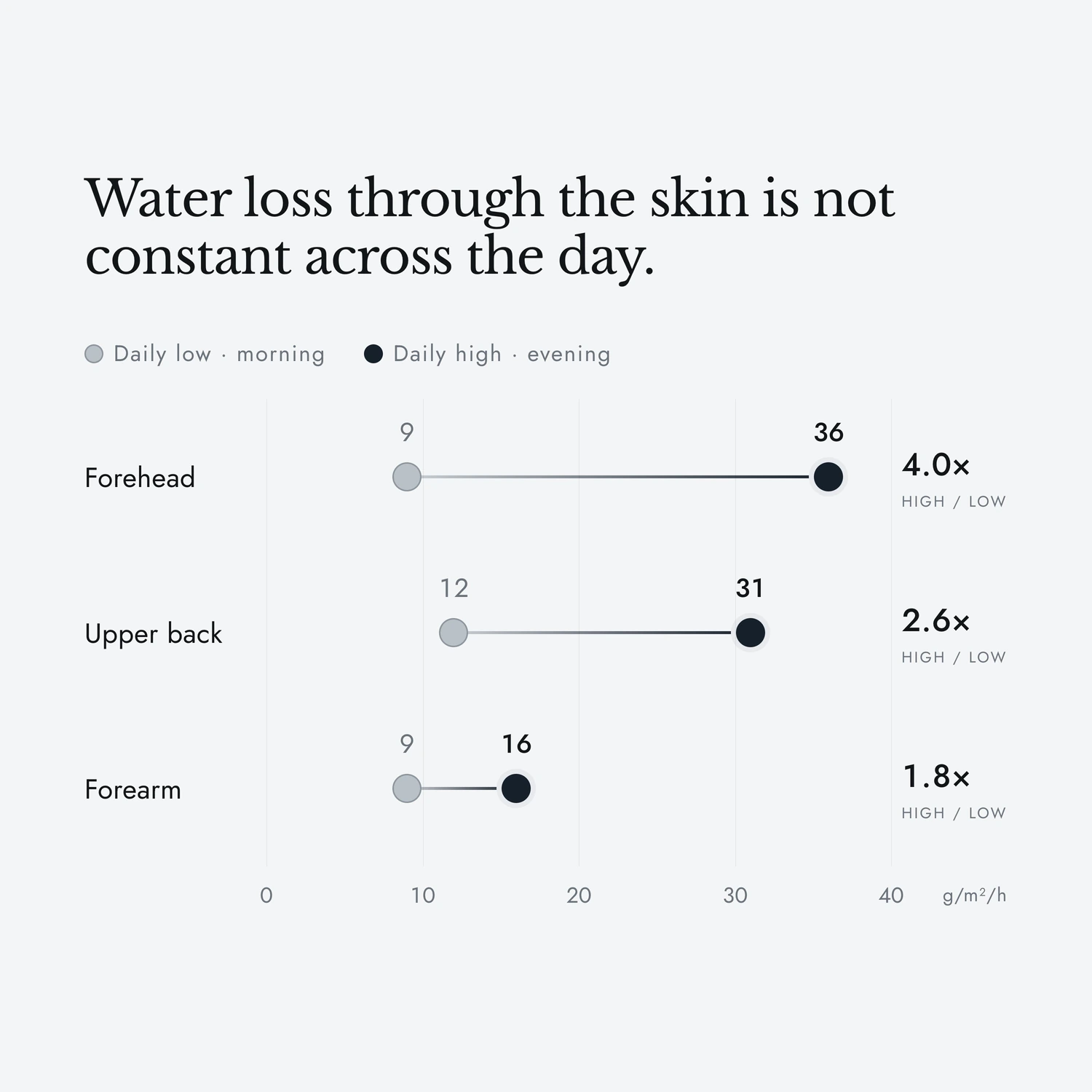
In a 24-hour human study, 16 healthy volunteers were measured every two hours. Transepidermal water loss, surface pH and skin temperature showed significant time-dependent rhythms; the authors concluded that permeability was higher in the evening and night than in the morning.[3]
A wider review likewise found TEWL higher in the afternoon and evening, while skin blood flow was lowest in the morning, highest in the afternoon and showed a second peak just before sleep.[1] The body is also turning toward heat loss as it prepares for sleep.
In an observational study of 60 women, good sleepers showed 30% greater barrier recovery 72 hours after tape stripping than poor sleepers. The study found association, not proof that sleep alone caused every observed difference.[4]
A separate controlled model restricted healthy adults to two hours of sleep per night for 72 hours. Barrier recovery after an experimental wound took 5.0 days under restriction versus 4.2 days after adequate sleep.[5]
The honest product implication is simple: formulate for the evening window, but never imply that skincare substitutes for sleep, repairs circadian disruption, or performs the body’s biology on its behalf.

Remove sunscreen, makeup, sweat and the visible residue of the day before asking a treatment formula to remain in contact.
Use the formula that fits the night: targeted peptide care, measured retinol, a long-contact hydrogel or a light conditioning mist.
Pair potency with humectants, emollients and comfort-supporting ingredients so consistency is built into the formula.
Design texture and format for the hours available between cleansing and morning, rather than adding decorative steps.
These sources describe skin and sleep biology. They are not finished-product evidence for Lepique.

A beginner-friendly way to bring 0.1% retinol into an evening routine.
Read the guideWhy pure retinol changes color over time, and why performance stays the same.
Read the guideWhen a retinol-free, peptide-led eye cream makes more sense.
Read the guideWhere a 42g hydrogel mask fits, how long to wear it and what to do after.
Read the guideWhat HOCl does in a cosmetic mist and when to reach for it.
Read the guideLightest to richest: a simple order for an evening routine.
Read the guide


